
Satellite Farm Monitoring
Carbon Aggregation Programme · Remote Sensing Layer
How VELSTROM watches enrolled farms from orbit — the spectral indices, the pilot geographies, and what each image tells us about soil carbon, crop health, and practice compliance.
The Monitoring Layer
Every enrolled farm polygon is registered in VELSTROM's geospatial platform with GPS-verified boundaries. Sentinel-2 satellite imagery, acquired by the European Space Agency at 5 to 12 day intervals, is automatically ingested and processed through Google Earth Engine pipelines. Four spectral indices are computed for every pixel within every enrolled polygon at each pass: BSI, SAVI, NDWI, and CRSI.
These indices do not directly measure soil organic carbon — no satellite sensor can see 30 centimetres underground. What they measure is the surface signal that correlates with carbon dynamics: bare soil exposure after tillage, vegetation biomass during the growing season, soil moisture, and canopy stress from salinity or waterlogging. VELSTROM's machine learning model translates these surface signals into SOC estimates, calibrated against physical soil samples from enrolled districts.
The images below show what each index looks like over the pilot areas. GeoTIFF uploads are pending — placeholder frames indicate where each composite will appear.
The Four Indices
Each index is derived from specific Sentinel-2 spectral bands and captures a distinct aspect of the farm surface. Together they form the monitoring composite that feeds VELSTROM's SOC estimation model.
Bands · B11 (SWIR1), B4 (Red), B8 (NIR), B2 (Blue)
Range · −1 to +1 · Higher = more exposed bare soil
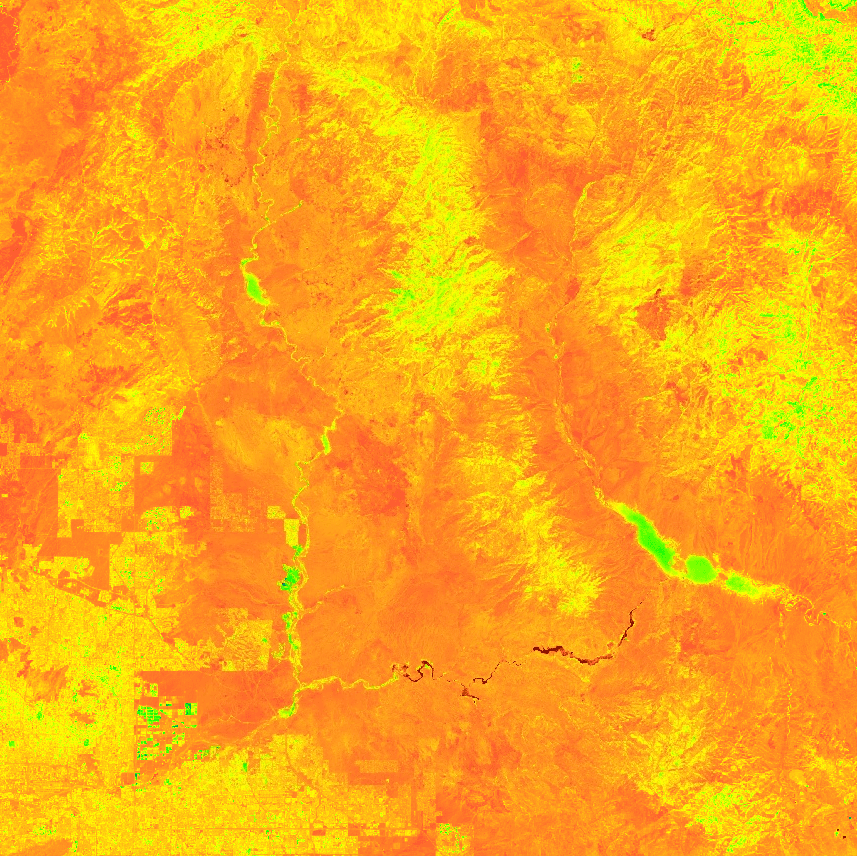
BSI composite — Kharif harvest window, October–November. Bright areas indicate freshly tilled or harvested fields.
BSI distinguishes bare soil from vegetated and built-up surfaces. In the carbon programme context, it is the primary tillage detection index: a sharp BSI increase over an enrolled plot between two consecutive Sentinel-2 passes indicates a ploughing or soil disturbance event. Post-harvest BSI rise without a corresponding fire signal indicates residue incorporation rather than burning.
- BSI > 0.2: High bare soil exposure — likely tillage or harvest with residue removal
- BSI 0.0–0.2: Partial cover — residue retention or early crop emergence
- BSI < 0.0: Dense vegetation or high moisture — active growing season
- Sudden BSI spike (>0.15 change between passes): Tillage event flagged for field agent follow-up
Bands · B8 (NIR), B4 (Red) · L = soil brightness correction factor
Range · −1 to +1 · Higher = denser, healthier vegetation
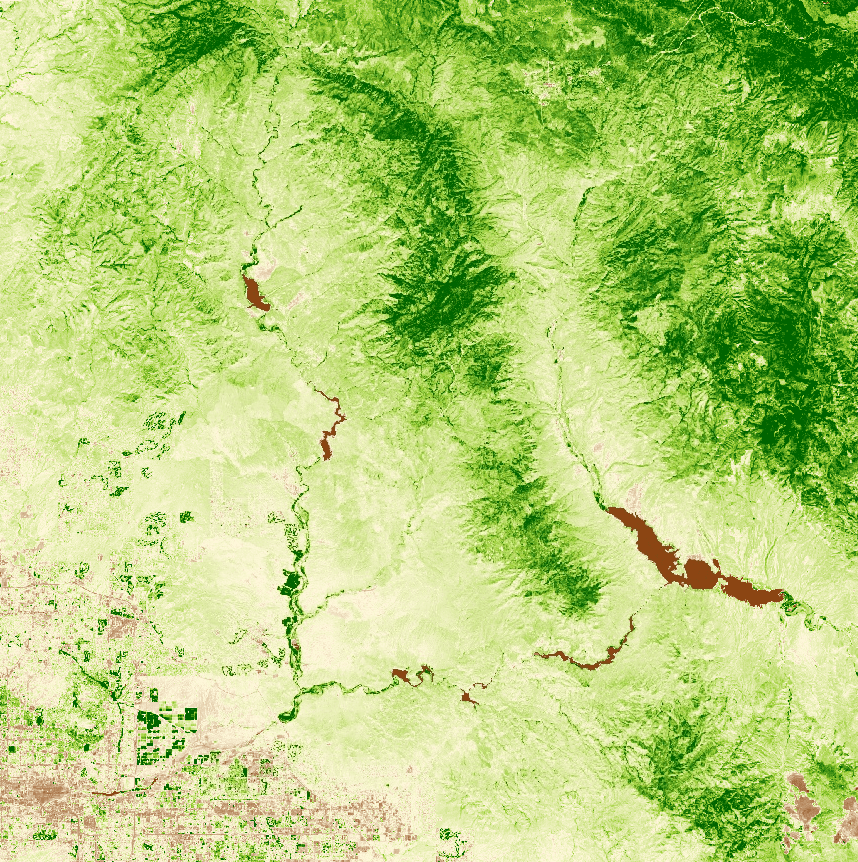
SAVI composite — Rabi peak, February. Green intensity indicates crop canopy density. Wheat and gram fields in Madhya Pradesh pilot districts.
SAVI corrects NDVI for soil background reflectance, making it more accurate in sparse vegetation conditions typical of early crop growth and dryland farming. In the carbon programme, SAVI tracks growing season biomass accumulation as a proxy for organic matter inputs to soil. Higher peak SAVI during the growing season correlates with greater above-ground biomass and, over time, greater soil organic matter inputs from root turnover and residue.
- SAVI > 0.5: Dense, healthy canopy — peak growing season, high biomass input expected
- SAVI 0.2–0.5: Moderate vegetation — early or late season, or dryland sparse crops
- SAVI < 0.2: Sparse or no vegetation — bare soil, fallow, or post-harvest
- Season-integrated SAVI (area under curve): Proxy for total biomass production and SOC input potential
Bands · B3 (Green), B8 (NIR)
Range · −1 to +1 · Higher = more water content (vegetation or surface)
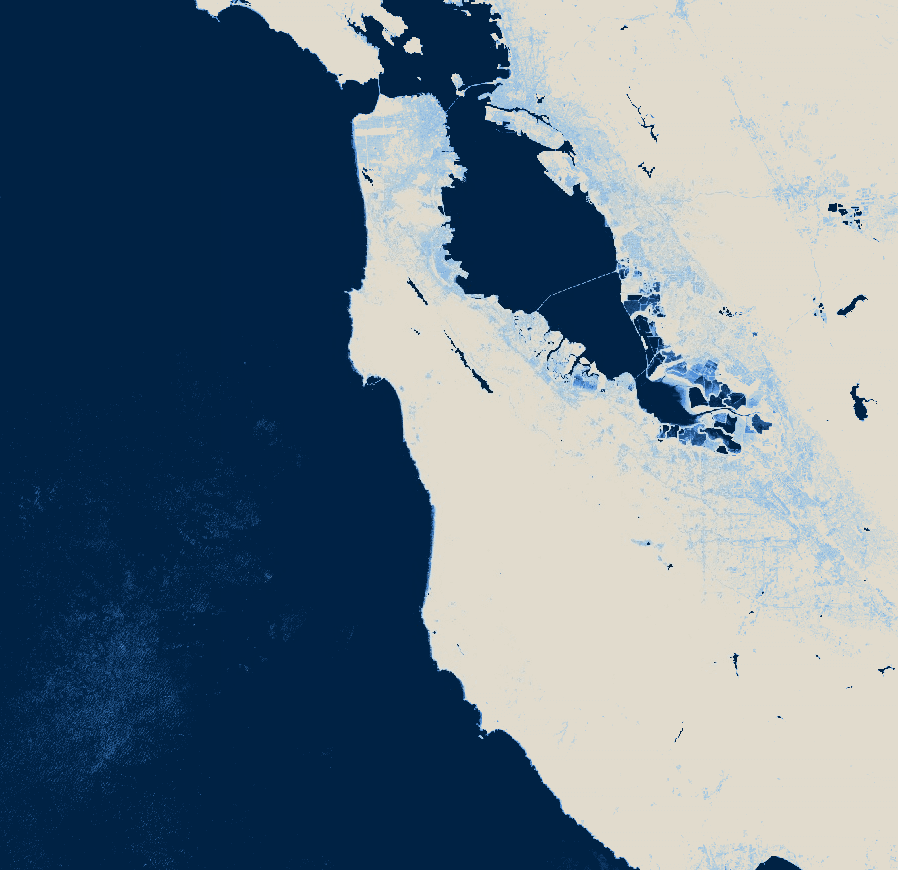
NDWI composite — Kharif peak, August. Blue-cyan areas indicate flooded paddy fields in Sangrur and Karimnagar. Dryland crops appear in neutral tones.
NDWI is sensitive to liquid water in vegetation canopies and, at lower values, to soil moisture. In the carbon programme it serves two roles: irrigation tracking (high NDWI in paddy fields confirms flooding status for AWD compliance monitoring) and crop stress detection (declining NDWI during the growing season indicates water stress, which affects biomass production and therefore SOC input estimates). In Punjab paddy districts, NDWI is the primary AWD compliance signal.
- NDWI > 0.3: Flooded or saturated — paddy fields under continuous flooding
- NDWI 0.0–0.3: Moist vegetation — irrigated crops, healthy canopy with moderate water
- NDWI −0.2–0.0: Dryland crops or moderate stress — rainfed soybean, wheat
- NDWI < −0.2: Dry bare soil or severe stress — fallow or drought-affected plots
- NDWI oscillation in paddy plots: AWD cycle detection — alternating wet/dry periods
Bands · B4 (Red), B11 (SWIR1), B3 (Green), B8 (NIR)
Range · 0 to ~1 · Higher = greater salinity or soil degradation stress
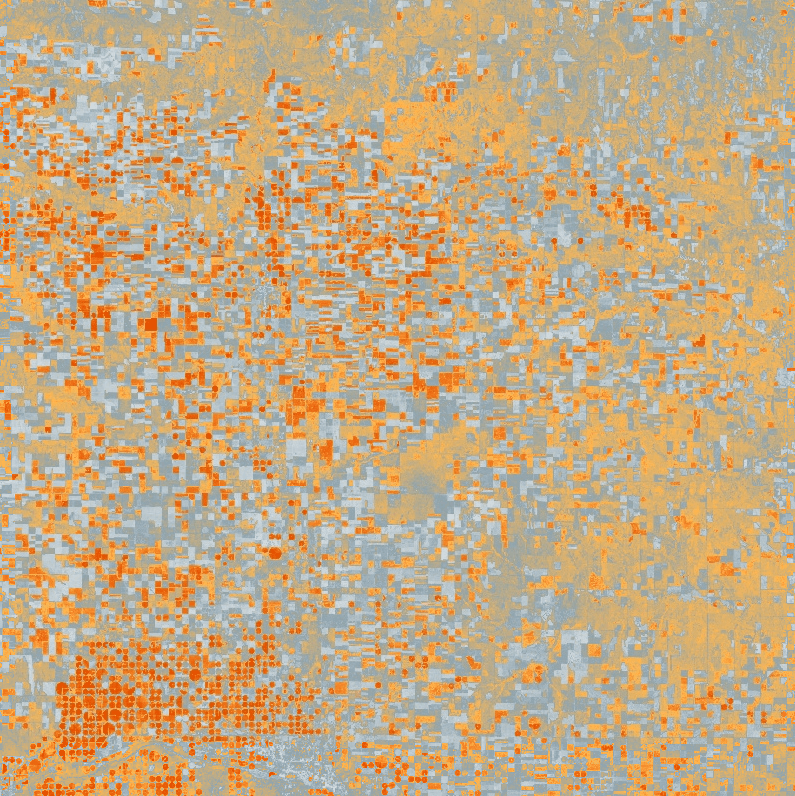
CRSI composite — post-monsoon, October. Purple-magenta areas indicate salinity or waterlogging stress. Telangana and Punjab districts shown.
CRSI detects salinity-induced stress in crop canopies by combining visible and shortwave infrared reflectance. Saline soils suppress vegetation growth and alter spectral response in characteristic ways that CRSI captures. In the carbon programme, CRSI is used to identify plots where soil degradation from salinity or waterlogging may be limiting SOC accumulation potential, and to flag areas where practice change may need to address soil health before carbon sequestration can be meaningfully measured.
- CRSI > 0.6: High salinity stress — canopy suppression, reduced biomass, limited SOC potential
- CRSI 0.4–0.6: Moderate stress — possible salinity or waterlogging, monitor closely
- CRSI 0.2–0.4: Low stress — healthy canopy, normal SOC accumulation expected
- CRSI < 0.2: Very low stress — optimal conditions, high SOC sequestration potential
- Persistent high CRSI across seasons: Soil health intervention recommended before enrollment
Where We Are Monitoring
Pilot areas were selected for farming intensity, soil carbon potential, and diversity of cropping systems. Each state represents a distinct agro-climatic zone with different monitoring priorities.
Pune
Sugarcane, soybean, jowar, wheat
Black cotton soil (Vertisol), medium deep
High sugarcane intensity in Indapur and Baramati talukas. Soybean dominant in kharif. Residue burning pressure moderate.
Satara
Sugarcane, soybean, groundnut, bajra
Lateritic and black soils, shallow to medium
Western ghats fringe districts with mixed agro-climatic zones. Groundnut in rain-shadow areas. Irrigation from Krishna basin.
Nashik
Grapes, onion, wheat, maize
Medium black and red soils
Grape cultivation dominant in Niphad and Dindori. High horticultural intensity. Onion residue management a key monitoring target.
Sangrur
Paddy (kharif), wheat (rabi), maize
Alluvial, deep loamy
Paddy-wheat rotation dominant. High residue burning incidence post-kharif harvest — primary fire detection target. AWD (alternate wetting and drying) pilot zone.
Barnala
Paddy, wheat, cotton
Sandy loam alluvial
Adjacent to Sangrur. Cotton in some blocks. Stubble burning monitoring active. Soil carbon baseline lower than Sangrur due to lighter texture.
Fatehgarh Sahib
Paddy, wheat, vegetables
Deep alluvial, loam to clay loam
Peri-urban farming pressure. Higher vegetable diversity. Monitoring focuses on residue retention and cover crop adoption.
Hoshangabad (Narmadapuram)
Wheat, soybean, gram, mustard
Deep black cotton soil (Vertisol)
Narmada valley — among the most fertile belts in central India. Wheat dominant in rabi. Soybean in kharif. High SOC potential from deep Vertisols.
Sehore
Soybean, wheat, gram
Medium black soil
Soybean capital of India. Residue management after soybean harvest is a key monitoring event. Conservation tillage adoption growing.
Vidisha
Wheat, soybean, gram, lentil
Black and mixed red-black soils
Betwa river basin. Diverse cropping. Gram and lentil in rabi add nitrogen fixation benefit. Cover crop potential high.
Karimnagar
Paddy, cotton, maize, turmeric
Red sandy loam and black cotton soil
Paddy dominant in kharif under Sriramsagar irrigation. Cotton in dryland areas. Turmeric in Jagtial fringe. Residue burning post-paddy is primary monitoring target.
Nizamabad
Paddy, maize, turmeric, soybean
Red loam and black soils
Turmeric belt — Nizamabad is India's largest turmeric market. Paddy-maize rotation in irrigated areas. Soil carbon dynamics complex due to crop diversity.
Warangal
Paddy, cotton, chilli, maize
Red and lateritic soils, medium depth
Cotton and chilli in dryland blocks. Paddy under Kakatiya canal command. High agricultural intensity. NDWI monitoring critical for irrigation tracking.
All Indices at a Glance
All four indices rendered side-by-side over the pilot area extent.
Bare Soil Index
Soil-Adjusted Vegetation Index
Normalised Difference Water Index
Canopy Response Salinity Index
From Satellite to Signal
Image Acquisition
Sentinel-2 Level-2A (surface reflectance) imagery is ingested automatically via Google Earth Engine. Cloud masking uses the QA60 band and SCL layer. Only scenes with <20% cloud cover over enrolled polygons are used for index computation.
Index Computation
BSI, SAVI, NDWI, and CRSI are computed per-pixel over each enrolled farm polygon. Pixel-level statistics (mean, median, 10th/90th percentile) are extracted per polygon per pass and stored in the monitoring database with timestamp and scene ID.
Change Detection
Temporal differencing between consecutive passes flags anomalies: BSI spikes (tillage), NDWI drops (irrigation cessation), fire hotspot cross-reference from NASA FIRMS within 24 hours of detection. Flagged events trigger field agent notification.
SOC Model Input
Season-integrated index time series (BSI, SAVI, NDWI, CRSI) are combined with topographic variables (slope, aspect, elevation from SRTM) and soil texture data to form the feature vector for VELSTROM's ensemble SOC estimation model.
Annual Monitoring Report
At year-end, the full satellite record — all index time series, anomaly flags, fire events, and SOC model outputs — is compiled into the Annual Monitoring Report submitted to the ACVA for independent verification.
Read the Carbon Aggregation Programme
The satellite monitoring layer is one part of a five-phase annual cycle from farmer enrollment to CCC issuance. Read the full programme detail.